How Content Delivery Networks Affect SEO: Crawling, Site Speed, and Rankings

SEO Agency in Toronto

A critical factor now in shaping positive user experience and strong search engine visibility: how fast a website loads. Desktop or mobile, it hardly matters; users expect pages that load quickly and function without a hitch, every single time. This expectation certainly isn’t lost on search engines, which reward fast, reliable performance.

Talk to any genuinely experienced SEO Agency in Toronto and one theme comes up again and again: technical fixes, like implementing a Content Delivery Network (CDN), strengthen a website’s SEO foundation. Faster pages, smoother crawling, and stronger reliability: this is what a CDN brings to the table, driving deeper engagement and better search rankings in the process.

What Is a Content Delivery Network (CDN)?

Servers scattered across different geographic regions, all working as one distributed network: that’s the essence of a Content Delivery Network (CDN). A single origin server isn’t where the content comes from anymore; instead, a CDN caches static resources like images, CSS files, JavaScript, videos, and fonts across edge servers positioned all over the world.

Someone visits your site, and instantly the CDN pulls these resources from whatever server happens to sit nearest them. Less distance for data to cover means one thing: faster load times, plus a browsing experience that feels noticeably smoother.

Multiple cities, provinces, countries, if that’s where your customers are, a CDN keeps your website’s performance steady no matter which one they’re visiting from.

How Does a CDN Work?

A browser sends a request to the hosting server; that’s what happens every single time a visitor accesses a website. No CDN in place, and every request has to travel straight to the origin server, which can slow things down if the visitor’s far away or the server’s buried under heavy traffic.

Frequently requested content, stored on edge servers: that’s how a CDN simplifies the whole process. A visitor requests a webpage, the CDN locates the nearest server, and cached content gets delivered from right there. Only content that’s dynamic or uncached ever makes the trip back to the origin server.

Latency drops, server workload eases, and websites stay responsive, even when traffic spikes hard.

Why Site Speed Matters for SEO

Website speed shapes, directly and unmistakably, how users engage with your site. Too long a load time, and visitors leave. Consistent research backs this up, resulting in higher bounce rates and fewer conversions along the way.

Core Web Vitals and other page experience signals have also found their way into Google’s ranking considerations. It’s not that page speed alone decides rankings; rather, it plays into multiple factors affecting SEO performance, such as:

  • A noticeably improved user experience
  • Engagement from visitors that increases
  • Bounce rates that end up lower
  • Potential for conversion that’s higher
  • Usability on mobile that gets better
  • Rendering of pages that happens faster

More pages get explored, more time gets spent on-site, and desired actions, enquiries submitted, and purchases made get completed once a website loads fast.

How CDNs Support Search Engine Crawling

Automated bots handle the discovery, crawling, and indexing of website content for search engines. Respond slowly, or go down often, and a website sees search engines crawl fewer pages during each visit.

Server response times drop, website stability improves; this is exactly how a CDN boosts crawling efficiency. Speed up responses, and search engine bots reach more pages within their available crawl budget, raising the odds that new or updated content gets discovered and indexed quickly. Among the many technical SEO considerations the Best SEO Company in Toronto evaluates when optimizing a website for long-term organic performance, this one still stands out.

Spread traffic across multiple servers, though, and the risk of server overload drops; websites stay accessible even during traffic spikes. Search engines crawl websites far more consistently thanks to this reliability, strengthening indexation overall.

How CDNs Contribute to Better Search Rankings

No, a CDN isn’t a direct ranking factor, but it shapes several things search engines look at when judging website quality.

Faster Page Load Times

Nearby servers take over content delivery, cutting loading delays and lifting the browsing experience as a whole. Visitors stick around on faster pages instead of drifting off, which trims abandonment and opens up more room for conversions.

Improved Core Web Vitals

Loading performance, responsiveness, and visual stability: that’s the trio Core Web Vitals track. Set up a CDN properly, and metrics like Largest Contentful Paint (LCP) climb, since images and other static assets move more efficiently.

Lower Bounce Rates

Instant loading, more or less, is simply what visitors expect now. Users tend to bail before ever engaging with content whenever a page drags. CDNs push loading speed up and, in turn, keep people on the site longer, building positive engagement signals as it goes.

Greater Website Reliability

User experience takes a hit, and so does crawling, whenever outages or performance problems strike a server. Traffic gets spread across multiple servers under a CDN, letting websites absorb sudden demand spikes without availability taking a hit.

Better Mobile Performance

Mobile devices bring their own mix of network conditions, and that’s how most users now reach websites. Whatever the connection speed, a CDN smooths out content delivery; faster, more reliable, and squarely in step with Google’s mobile-first indexing approach.

Enhanced Security

DDoS mitigation, SSL support, traffic filtering: security features like these ship with most CDN providers. Rankings don’t move on security alone, granted, but keeping a website available builds user trust and keeps search engines reaching your content without a hitch.

Which Businesses Benefit Most from a CDN?

Nearly any website stands to gain from improved performance, true, yet some businesses see even greater value in implementing a CDN. These include:

  • Product catalogues that run extensively on e-commerce websites
  • Firms offering professional services across multiple locations
  • Local businesses are putting money into organic search visibility
  • Portfolios and websites that lean heavily on images
  • Membership websites and educational platforms alike
  • Businesses riding seasonal spikes or high-volume traffic

Larger audiences follow as websites grow, and keeping performance fast and consistent only grows more important, for users and search engines both.

Common CDN Mistakes That Can Affect SEO

Simply enabling a CDN does not automatically improve SEO. Proper configuration is essential to avoid technical issues that could negatively impact website performance.

Some common mistakes include:

  • Serving outdated cached content after website updates
  • Improper cache settings that prevent important pages from refreshing
  • Incorrect redirect configurations
  • Mixed-content warnings caused by inconsistent HTTP and HTTPS settings
  • Failing to monitor CDN performance over time

Regular technical audits help identify and resolve these issues before they affect user experience or search visibility.

Why Technical SEO Expertise Still Matters

A CDN, on its own, covers only one piece of a comprehensive technical SEO strategy. Architecture, crawlability, structured data, page optimization, internal linking, and ongoing performance monitoring- together, these drive the kind of growth that actually sustains itself.

Isolation is the enemy here, and an experienced SEO Agency in Toronto makes sure these technical elements never operate that way. What comprehensive audits uncover includes speed bottlenecks, server inefficiencies, indexing issues, and opportunities to improve overall website performance.

Many businesses find real value in modern AI-driven SEO solutions, too, tools that analyse website data more efficiently, flag technical issues, and surface optimization opportunities easy to miss otherwise. Blend that with seasoned human expertise, and what emerges are SEO strategies that are smarter and genuinely data-informed.

Technical excellence, paired with content strategy and long-term organic growth, that combination is what businesses should seek out when they go looking for the Best SEO Company in Toronto.

Conclusion

Modern website performance now leans heavily on one essential component: Content Delivery Networks. Search rankings don’t move directly because of them, true, but they strengthen many technical factors shaping SEO: faster page speeds, better crawl efficiency, stronger Core Web Vitals, and an overall smoother user experience. Sustainable organic visibility gets a firmer foundation from these improvements, all while visitors enjoy a website that’s faster and more dependable.

A properly configured CDN, folded into a broader technical SEO strategy, is where partnering with a knowledgeable SEO Agency in Toronto really pays off. Businesses find themselves better positioned to boost search rankings, draw in qualified traffic, and reach long-term digital growth once performance, technical optimization, and strong content all move together.

A Step-by-Step Guide to Showcasing Your Products in ChatGPT Shopping Results

SEO company Toronto

The way people find products online has changed, and it’s moving fast. Traditional search engines still matter, but AI platforms like ChatGPT are quietly reshaping how shoppers research, compare, and actually decide what to buy. Instead of clicking through pages of results, people are getting tailored product recommendations in a matter of seconds.

For businesses in Toronto, the GTA, and beyond, that shift is worth paying attention to. Brands that align their online presence with how AI-powered search works have a real shot at reaching high-intent customers before their competitors do. That’s where AI-Driven SEO comes in. When AI systems can clearly understand, evaluate, and recommend your products, your chances of showing up in ChatGPT Shopping results and other emerging AI search environments go up considerably.

If you want your products to turn up in AI-generated recommendations, the starting point is understanding how ChatGPT actually finds and assesses product information in the first place.

Understanding How ChatGPT Finds Product Information

To put together product recommendations, ChatGPT draws on a mix of sources, search engine indexes, structured data, retailer websites, product feeds, reviews, and reputable online marketplaces, among others.

Once a user asks for product suggestions, the platform digs into whatever information is available and works out which products line up with what that person actually wants. Product quality, website authority, stock availability, pricing, reviews, and content relevance can all play a role in whether a product ends up being recommended.

Businesses that invest in solid AI-Driven SEO strategies give AI systems a much easier time understanding their products and a better shot at surfacing them in relevant shopping conversations.

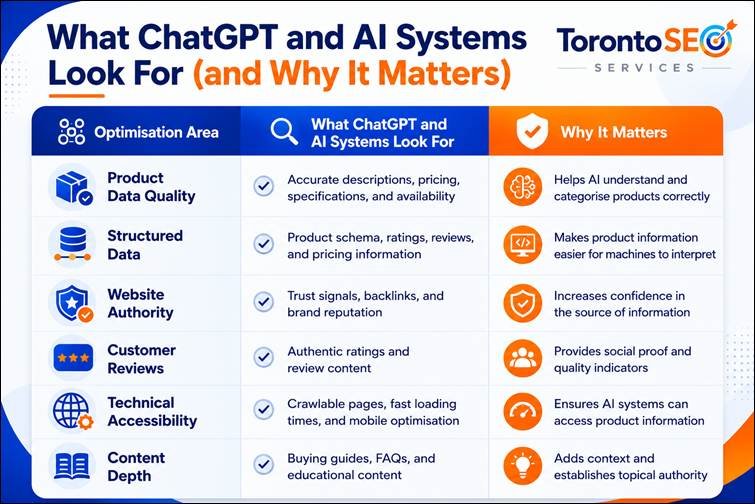
To understand what’s really moving the needle on product visibility, take a look at these key optimisation factors:

Now let’s look at the practical steps you can take to improve your product visibility.

Step 1: Optimise Your Product Pages

Here’s the thing: AI systems can only work with what you give them. Your product pages are usually the main input, so gaps in information there tend to show up as gaps in visibility later. Build out pages that genuinely cover:

  • Unique product descriptions
  • Detailed feature lists
  • Clear benefits and use cases
  • Accurate pricing information
  • Inventory and availability updates
  • High-quality images
  • Product specifications

Borrowed manufacturer copy might save time upfront, but it blends you in rather than setting you apart. Your own words, specific, honest, and detailed, are what give shoppers and AI-powered search systems a reason to land on your product over someone else’s.

Step 2: Implement Structured Data Markup

Structured data, or schema markup, if you’ve heard it called that, is basically how you help search engines and AI platforms actually make sense of what’s on your website.

With product schema, you can spell out the details that matter:

  • Product names
  • Pricing
  • Availability
  • Brand information
  • Product ratings
  • Customer reviews
  • Product images

When it’s set up properly, you’re giving AI systems information they can read and use directly, which tends to work in your favour across both traditional search and newer AI-powered experiences.

A decent way to think about it: schema markup is less about adding more content and more about giving AI a clear map so it’s not left guessing what your product actually is.

Step 3: Build Website Authority

AI recommendation systems tend to favour products from websites that have actually earned some credibility. If yours reads as a trusted source in your space, your products are in a better position to get pulled into recommendations.

A few things that genuinely move the needle:

  • Publishing valuable industry content
  • Earning backlinks from reputable websites
  • Generating positive customer reviews
  • Maintaining consistent business information online
  • Building brand recognition within your niche

Trust is a big deal in regular search and in AI-powered discovery alike. The stronger your reputation out there, the more comfortable AI systems are pointing people toward what you sell.

Step 4: Leverage Customer Reviews and Social Proof

Reviews carry real weight in how people decide what to buy, and AI platforms know it. They regularly factor in review signals when they’re working out whether a product is worth recommending.

If someone had a good experience, make it easy for them to say so. Work on:

  • Increasing review volume
  • Improving average ratings
  • Responding to customer feedback
  • Showcasing user-generated content
  • Highlighting testimonials

Reviews do double duty here. They help shoppers feel confident pulling the trigger on a purchase, and they hand AI systems the kind of quality and satisfaction signals that can nudge your products higher up in recommendations.

Step 5: Improve Technical SEO Foundations

Even the best product content can struggle to gain visibility if your website has technical issues. Good product content can get buried fast if there’s something off under the hood. Run through the basics and make sure your site is:

  • Easily crawlable
  • Properly indexed
  • Mobile-friendly
  • Fast-loading
  • Secure
  • Free from broken links

Your XML sitemap needs to stay current, and crawl errors are worth checking on regularly; that’s what lets search engines and AI systems actually get to your product pages instead of hitting dead ends.

A clean, well-functioning site pulls weight in two directions at once: people who land on it have a better time, and your visibility across platforms doesn’t take unnecessary hits.

Step 6: Create Supporting Content Around Your Products

Product pages alone won’t cut it with AI systems; they’re looking at the whole picture of what your site has to offer. Surround your products with content that adds real context and shows you understand your industry.

That might look like:

  • Buying guides
  • Product comparisons
  • Frequently asked questions
  • How-to articles
  • Industry trend reports
  • Product tutorials

When people keep landing on your site for answers, that’s your brand building a reputation, and AI systems pick up on that too.

Businesses offering Organic SEO Services have known this for a while. Content marketing isn’t a side strategy; it’s often the thing holding up visibility, authority, and search performance over the long haul.

Step 7: Optimise Product Images and Visual Assets

Visuals are doing more heavy lifting in online shopping than they used to, and that goes for AI systems as much as it does for actual shoppers. Images that are properly set up give both a much clearer read on what you’re selling. A few things worth getting right:

  • Using high-resolution images
  • Including multiple product angles
  • Writing descriptive file names
  • Adding relevant alt text
  • Compressing images for faster loading
  • Showcasing products in real-world settings

When your visuals are genuinely good, people stay longer, buy more often, and AI recommendation systems have more context to work with, all from something as straightforward as putting real thought into your photos.

Step 8: Track Performance and Refine Your Strategy

Getting your optimisation in order isn’t a one-time job. AI-powered shopping keeps shifting, and your strategy needs to shift with it. Keep an eye on numbers that actually tell you something:

  • Organic traffic
  • Product page engagement
  • Conversion rates
  • Referral traffic
  • Search visibility
  • Revenue generated from organic channels

Sit down with your data regularly, not just to see what’s working, but to catch what isn’t before it becomes a bigger problem. Patterns show up over time, and those patterns are where your next round of improvements usually hides.

A lot of businesses that want to stay ahead of where search technology is heading work with an experienced SEO Company in Toronto. Having someone in your corner who understands both traditional search visibility and AI-powered product discovery makes the whole thing a lot more manageable.

Preparing for the Future of AI-Powered Commerce

AI shopping experiences aren’t a trend worth watching from the sidelines; they’re already shifting how people buy things, and the pace isn’t slowing down. Shoppers have come to expect recommendations that feel relevant, answers that come fast, and a buying process that doesn’t make them work for it.

As AI tools take on a bigger role in how purchasing decisions get made, the businesses cleaning up their product data, tightening their website content, and keeping their technical infrastructure in good shape are the ones that will hold their ground and grow.

The brands that come out ahead won’t be the ones obsessing over rankings alone. They’ll be the ones getting the details right, accurate information, experiences that don’t frustrate people, and a reputation customers actually trust at every point along the way.

Conclusion

AI-powered shopping isn’t on its way; it’s already here, and it’s changing how people find and buy things online. Businesses that aren’t adjusting how they optimise are going to feel that gap widen. Stronger product pages, structured data, website authority, customer reviews, and solid technical fundamentals all feed into whether your products show up in ChatGPT Shopping results or get passed over.

A proper AI-Driven SEO strategy does more than check boxes for traditional search; it puts your products in a position where AI platforms can actually understand them and feel confident recommending them. The businesses putting in that work now aren’t just keeping up; they’re getting ahead of a shift that’s only going to matter more as AI-powered product discovery becomes a bigger part of how Canadians shop online.

Why Every Toronto Business Needs a Fast Website in 2026

Fast website optimization helping Toronto businesses improve user experience, SEO rankings, and lead generation.

Why Every Toronto Business Needs a Fast Website in 2026

Your website is often the first interaction potential customers have with your business. In today’s competitive digital environment, visitors expect websites to load quickly and provide a seamless browsing experience.

If your website is slow, difficult to navigate, or outdated, potential customers may leave before ever contacting your business.

For Toronto businesses, website speed has become one of the most important factors influencing search engine rankings, user experience, and lead generation.

First Impressions Matter

Studies consistently show that website visitors form an opinion about a website within seconds.

A slow-loading website can create frustration and reduce trust in your business. Consumers expect pages to load almost instantly, especially when browsing from mobile devices.

Businesses that invest in professional Web Development Services often experience improved user engagement, longer visit durations, and higher conversion rates.

Website Speed Impacts SEO

Google considers website performance when evaluating search rankings.

A fast website helps search engines crawl content more efficiently while providing a better user experience. Websites that load quickly tend to have lower bounce rates and higher engagement levels.

Businesses that combine website optimization with SEO Services Toronto frequently see improvements in both rankings and organic traffic.

Mobile Users Expect Fast Performance

More than half of website traffic now comes from mobile devices.

Whether customers are searching for a contractor, restaurant, consultant, or service provider, they expect fast access to information on their phones.

Mobile users are particularly likely to leave a website if pages load slowly or navigation becomes difficult.

Optimizing images, improving server performance, and reducing unnecessary code can significantly improve mobile performance.

Faster Websites Generate More Leads

Website speed directly impacts conversions.

When visitors can easily navigate your website and find the information they need, they are more likely to complete contact forms, call your business, or request a quote.

Even small improvements in page speed can lead to noticeable increases in lead generation and customer inquiries.

Ongoing Maintenance Is Essential

Website performance is not a one-time project.

Regular updates, security patches, plugin maintenance, image optimization, and technical monitoring are necessary to keep a website running efficiently.

Many businesses rely on Website Maintenance Services to ensure their websites remain secure, fast, and optimized throughout the year.

Investing in Performance Pays Off

A fast website improves user experience, strengthens search rankings, increases conversions, and supports long-term business growth.

As competition continues to increase across Toronto, businesses that prioritize website performance will be better positioned to attract customers and generate leads online.

If your website has not been evaluated recently, now may be the perfect time to assess its performance and identify opportunities for improvement.

How Our SEO Agency in Toronto Turns Clicks Into Loyal Customers

SEO agency Toronto

Every company operating in the GTA yearns for a top ranking for its local keyword, but very few achieve it. It is this connection that we establish via Toronto SEO Services, where our SEO solutions ensure that our customers get ahead of the competition to capture the attention of the buyer looking to take action. Unlike many other agencies, our SEO agency in Toronto does not just focus on ranking but establishes digital authority even before the prospect makes the call.

Continue reading

How Smart GTA Businesses Climb Google With Toronto SEO Services

Toronto SEO Services

Every business in the Greater Toronto Area is fighting for attention in a crowded digital landscape. Customers search online before they walk through any door, call any number, or place any order. That is why we deliver expert Toronto SEO Services designed to connect your brand with ready-to-buy customers at precisely the right moment. Our strategies are practical, transparent, and built around real growth. We do not chase vanity metrics; we chase results that move your business forward every single month. We focus on aligning search intent with clear messaging and structured optimization that helps your business stay visible and competitive across evolving search environments.

We also seek to comprehend the local competition’s activities across different search channels to optimize positioning for your business among users with high intent. Our procedure involves extensive research and implementation, making sure that every step of optimization contributes towards your internet profile and creates digital authority in the ever-evolving world of search. By monitoring shifts in ranking positions, user behavior, and content-related signals, we manage to constantly improve our approach and continue growing steadily.

Toronto SEO Services and the Science of Local Search Visibility

Understanding How Google Picks Its Winners

There are dozens of signals that search engines consider before ranking any site. Relevancy, authority, and user experience all contribute to whether you see someone at the top or you end up being buried on the second page. Companies that ensure that their websites are aligned with these signals always perform better than those that ignore them. We inspect all levels of your online presence, so you can be confident that nothing is holding you back from the rankings your business can achieve.

Mapping Keywords to Genuine Customer Intent

All search phrases do not have the same commercial weight. There are those questions that are indicative of curiosity, and there are those that indicate a customer who has a credit card in his or her hand. Toronto SEO Services, which locates high-intent keywords and incorporates them into your content automatically, develops a flow of qualified visitors who are ready to engage. We study your market and then write a single word or amend a single page element.

On-Page Optimization That Converts Visitors Into Clients

Crafting Pages That Speak Both to Google and to People

An optimized page is a page that is doing two things. It meets search engine requirements by incorporating structured headings, clean URLs, and appropriate metadata, and meets real visitor requirements by being clear, compelling, and easy to navigate. By re-writing and re-organizing pages, our team ensures that both sets of audiences walk away satisfied, and this reduces the number of bounces as well as communicating quality to Google in an effective loop of improvement.

Internal Linking as a Revenue Architecture Tool

Internal links are considered to be basic navigation tools by most businesses. We consider them as a roadmap that takes a visitor further into your site and distributes authority around your most lucrative pages. The interlinking of service pages, location pages, and blog content with intentional internal links helps us to build the overall ranking strength of your whole domain, and not leave any page as a solitary island.

Local SEO Strategies Across the GTA

Google Business Profile Optimization for Maximum Map Visibility

Before a prospective customer visits your site, they will probably look at your Google Business Profile. A neglected profile with missing hours, sparse photos, and unanswered reviews sends the wrong signal.  We optimize each field, collect authentic reviews of clients, and update regularly, so your profile will be a living and breathing sales tool that will make people trust it before they even click through to your website.

Geo-Targeted Content for Neighbourhoods and Surrounding Cities

Businesses serving Toronto SEO Services clients across Mississauga, Brampton, Vaughan, and Markham need content that speaks to each community individually. The generic city-wide pages do not tend to be ranked highly in hyper-local searches with the highest purchase intentions. Our writers create neighbourhood-based opening pages that allude to local features, services, and customer concerns so that your business becomes something like a natural extension of each of the communities you serve.

Conclusion

Toronto SEO Services is the best long-term investment that a GTA business can make in its digital growth. We blend neighborhood savvy, technical accuracy, and content strategy into a single solution that grows more valuable every month. We are not working on short-term gimmicks, but on a long-term competitive advantage. Contact us today, and we will draw up the specific steps that your business must follow in order to take over search results throughout Toronto and all of the surrounding communities.

How Much Does SEO Cost in Toronto? (2026 Guide)

How Much Does SEO Cost in Toronto?

If you’re considering SEO for your business, one of the first questions you’ll ask is: how much does SEO cost in Toronto?

The answer depends on several factors, including your industry, competition, and the scope of work required. Understanding SEO pricing can help you make the right investment for long-term growth.


What Influences SEO Pricing?

SEO costs can vary depending on:

  • Competition in your industry
  • The number of keywords you want to target
  • The size and condition of your website
  • The level of ongoing optimization required

Highly competitive markets like Toronto typically require a more strategic and consistent approach.


Typical SEO Pricing in Toronto

While prices vary, most businesses can expect:

  • Basic SEO: $500 – $1,000/month
  • Mid-level SEO: $1,000 – $3,000/month
  • Advanced SEO: $3,000+/month

The right investment depends on your goals and how aggressive you want your growth to be.


What Should Be Included in SEO Services?

A reliable SEO strategy should include:

  • Keyword research and planning
  • On-page optimization
  • Technical SEO improvements
  • Content creation
  • Link building

Working with a provider that offers complete SEO services ensures that all aspects of your online presence are optimized.


Cheap SEO vs Quality SEO

It can be tempting to choose the cheapest option, but low-cost SEO often leads to poor results or even penalties.

Quality SEO focuses on:

  • Long-term growth
  • Sustainable strategies
  • Real traffic and lead generation

Choosing the right partner makes a significant difference in your results.


SEO vs Paid Advertising Costs

SEO is a long-term investment, while paid ads provide immediate results.

Many businesses combine SEO with Google Ads services to maximize both short-term and long-term performance.


Is SEO Worth the Investment?

SEO is one of the most cost-effective marketing strategies over time. Once your website starts ranking, it can generate consistent traffic without ongoing ad spend.

For businesses in Toronto, SEO can be a key driver of growth and long-term success.


Final Thoughts

SEO pricing varies, but the right investment can deliver significant returns.

By understanding what goes into SEO costs, you can make informed decisions and choose a strategy that aligns with your business goals.

How Physiotherapy Clinics in Brampton Can Get More Patients with SEO

Physiotherapy clinic in Brampton using SEO to attract more patients and increase bookings

Physiotherapy clinics in Brampton are facing increasing competition, making it harder to attract new patients online. If your clinic isn’t ranking on the first page of Google, potential patients are choosing competitors instead.

Most clinics still rely on referrals, but today, patients search online before booking.


Why Physiotherapy Clinics in Brampton Struggle Online

Many clinics have websites but fail to generate consistent patient bookings.

Common issues include:

  • Not targeting local keywords like “physiotherapy Brampton”
  • Weak website structure and poor user experience
  • No Google Maps visibility
  • Lack of backlinks

How SEO Helps You Get More Patients

SEO helps your clinic appear when people search for:

  • “physiotherapy near me”
  • “sports injury clinic Brampton”
  • “back pain treatment Brampton”

This leads to:

  • More website traffic
  • More phone calls
  • More appointment bookings

What Works for Physiotherapy SEO in 2026

To compete in Brampton, clinics should focus on:

  • Location-specific content targeting Brampton
  • Optimized service pages for treatments
  • Strong Google Business Profile optimization
  • High-quality backlinks

Final Thoughts

If your physiotherapy clinic isn’t ranking on Google, you’re missing out on new patients every day.

👉 Learn more about our SEO for physiotherapy clinics in Brampton:

How Physiotherapy Clinics in Mississauga Can Get More Patients with SEO in 2026

Physiotherapy clinic in Mississauga using SEO to attract more patients and increase bookings

Physiotherapy clinics in Mississauga are facing increasing competition, making it harder to attract new patients online. If your clinic isn’t ranking on the first page of Google, potential patients are choosing competitors instead.

Most clinics rely on referrals or outdated marketing — but today, patients search online first.


Why Physiotherapy Clinics in Mississauga Struggle Online

Many clinics have websites but fail to generate consistent leads.

Common issues include:

  • Not targeting local keywords like “physiotherapy Mississauga”
  • Weak website structure and slow performance
  • No Google Maps optimization
  • Lack of backlinks

How SEO Helps You Get More Patients

SEO helps your clinic appear when people search for:

  • “physiotherapy near me”
  • “sports injury clinic Mississauga”
  • “back pain treatment Mississauga”

This leads to:

  • More website traffic
  • More calls
  • More appointment bookings

What Works for Physiotherapy SEO in 2026

To compete in Mississauga, clinics should focus on:

  • Location-specific service pages
  • Optimized content targeting local searches
  • Strong Google Business Profile
  • High-quality backlinks

Final Thoughts

If your clinic isn’t ranking on Google, you’re missing out on new patients every day.

👉 Learn more about our SEO services in Mississauga

How Physiotherapy Clinics in Toronto Can Get More Patients with SEO in 2026

Physiotherapy clinic in Toronto using SEO to attract more patients and increase bookings

Physiotherapy clinics in Toronto face increasing competition both online and offline. If your clinic isn’t showing up on the first page of Google, potential patients are booking with your competitors instead.

Most clinics rely on word-of-mouth or outdated marketing — but today, patients search online first.


Why Most Physiotherapy Clinics Struggle Online

Many clinics have websites, but they aren’t optimized to generate leads.

Common issues include:

  • Not targeting the right local keywords
  • Weak or outdated website structure
  • No Google Maps optimization
  • Little to no backlinks

This results in low visibility and missed opportunities.


How SEO Helps You Get More Patients

SEO puts your clinic in front of people actively searching for services like:

  • “physiotherapy near me”
  • “sports injury clinic Toronto”
  • “back pain treatment Toronto”

When your clinic appears at the top, you get more:

  • Website visits
  • Phone calls
  • Appointment bookings

What Works for Physiotherapy SEO in 2026

To compete in Toronto, clinics need:

  • Location-specific landing pages
  • Optimized service pages (injury, rehab, etc.)
  • Strong Google Business Profile presence
  • High-quality backlinks from trusted sources

Consistency is key — SEO is not a one-time effort.


Final Thoughts

If your physiotherapy clinic isn’t ranking on Google, you’re leaving patient bookings on the table.

The right SEO strategy can change that.

👉 Learn more about our SEO services in Toronto

How to Choose the Right SEO Agency in Toronto (2026 Guide)

How to choose the right SEO agency in Toronto infographic

How to Choose the Right SEO Agency in Toronto

With so many SEO agencies in Toronto, choosing the right one can feel overwhelming. Every agency promises rankings, traffic, and results — but not all of them deliver.

If you’re investing in SEO, it’s important to partner with a team that understands your business, your market, and how to generate real results.

Look for Proven Results, Not Promises

Many agencies make big claims but fail to show real outcomes. A reliable SEO agency should be able to demonstrate:

– Improved keyword rankings
– Increased website traffic
– Real lead generation

When evaluating an agency, focus on results — not just marketing language.

Understand Their SEO Strategy

A good SEO agency should clearly explain how they plan to improve your rankings.

Look for services that include:

– Keyword research
– On-page optimization
– Technical SEO improvements
– Content strategy
– Link building

If an agency can’t explain their approach, it’s a red flag.

https://torontoseoservices.com/seo-services/

Avoid Long-Term Contracts

Many businesses get locked into long-term contracts with little to no results.

Choose an agency that offers:

– Flexible plans
– Transparent pricing
– Performance-based strategies

This shows confidence in their ability to deliver.

Focus on Local Experience

Toronto is a highly competitive market. You need an agency that understands local search trends and competition.

A team with experience in the Toronto and GTA market can:

– Target the right keywords
– Optimize for local searches
– Improve your visibility where it matters most.

Look Beyond Rankings

Ranking #1 on Google is great — but it doesn’t always mean more business.

The right SEO agency focuses on:

– Driving qualified traffic
– Increasing conversions
– Generating real leads

SEO should support your business growth, not just vanity metrics.

Check Communication and Reporting

A professional agency should keep you informed with:

– Regular updates
– Clear reporting
– Measurable results

You should always know what’s being done and how your campaign is performing.

Combine SEO with Other Strategies

The best agencies understand that SEO works even better when combined with other channels.

For example, pairing SEO with Google Ads services can help you generate immediate traffic while building long-term growth.

https://torontoseoservices.com/google-ads-service/

Final Thoughts

Choosing the right SEO agency can make a major difference in your business growth.

Take your time, ask the right questions, and focus on agencies that prioritize real results, transparency, and long-term success.