
The way people find products online has changed, and it’s moving fast. Traditional search engines still matter, but AI platforms like ChatGPT are quietly reshaping how shoppers research, compare, and actually decide what to buy. Instead of clicking through pages of results, people are getting tailored product recommendations in a matter of seconds.
For businesses in Toronto, the GTA, and beyond, that shift is worth paying attention to. Brands that align their online presence with how AI-powered search works have a real shot at reaching high-intent customers before their competitors do. That’s where AI-Driven SEO comes in. When AI systems can clearly understand, evaluate, and recommend your products, your chances of showing up in ChatGPT Shopping results and other emerging AI search environments go up considerably.
If you want your products to turn up in AI-generated recommendations, the starting point is understanding how ChatGPT actually finds and assesses product information in the first place.
Understanding How ChatGPT Finds Product Information
To put together product recommendations, ChatGPT draws on a mix of sources, search engine indexes, structured data, retailer websites, product feeds, reviews, and reputable online marketplaces, among others.
Once a user asks for product suggestions, the platform digs into whatever information is available and works out which products line up with what that person actually wants. Product quality, website authority, stock availability, pricing, reviews, and content relevance can all play a role in whether a product ends up being recommended.
Businesses that invest in solid AI-Driven SEO strategies give AI systems a much easier time understanding their products and a better shot at surfacing them in relevant shopping conversations.
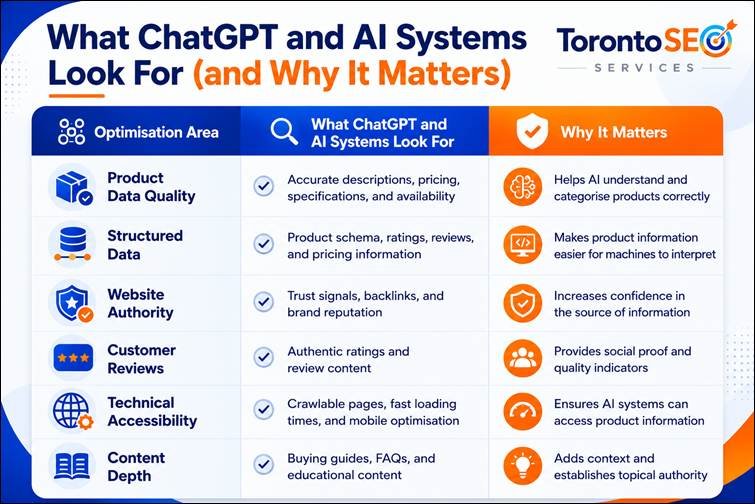
To understand what’s really moving the needle on product visibility, take a look at these key optimisation factors:
Now let’s look at the practical steps you can take to improve your product visibility.
Step 1: Optimise Your Product Pages
Here’s the thing: AI systems can only work with what you give them. Your product pages are usually the main input, so gaps in information there tend to show up as gaps in visibility later. Build out pages that genuinely cover:
- Unique product descriptions
- Detailed feature lists
- Clear benefits and use cases
- Accurate pricing information
- Inventory and availability updates
- High-quality images
- Product specifications
Borrowed manufacturer copy might save time upfront, but it blends you in rather than setting you apart. Your own words, specific, honest, and detailed, are what give shoppers and AI-powered search systems a reason to land on your product over someone else’s.
Step 2: Implement Structured Data Markup
Structured data, or schema markup, if you’ve heard it called that, is basically how you help search engines and AI platforms actually make sense of what’s on your website.
With product schema, you can spell out the details that matter:
- Product names
- Pricing
- Availability
- Brand information
- Product ratings
- Customer reviews
- Product images
When it’s set up properly, you’re giving AI systems information they can read and use directly, which tends to work in your favour across both traditional search and newer AI-powered experiences.
A decent way to think about it: schema markup is less about adding more content and more about giving AI a clear map so it’s not left guessing what your product actually is.
Step 3: Build Website Authority
AI recommendation systems tend to favour products from websites that have actually earned some credibility. If yours reads as a trusted source in your space, your products are in a better position to get pulled into recommendations.
A few things that genuinely move the needle:
- Publishing valuable industry content
- Earning backlinks from reputable websites
- Generating positive customer reviews
- Maintaining consistent business information online
- Building brand recognition within your niche
Trust is a big deal in regular search and in AI-powered discovery alike. The stronger your reputation out there, the more comfortable AI systems are pointing people toward what you sell.
Step 4: Leverage Customer Reviews and Social Proof
Reviews carry real weight in how people decide what to buy, and AI platforms know it. They regularly factor in review signals when they’re working out whether a product is worth recommending.
If someone had a good experience, make it easy for them to say so. Work on:
- Increasing review volume
- Improving average ratings
- Responding to customer feedback
- Showcasing user-generated content
- Highlighting testimonials
Reviews do double duty here. They help shoppers feel confident pulling the trigger on a purchase, and they hand AI systems the kind of quality and satisfaction signals that can nudge your products higher up in recommendations.
Step 5: Improve Technical SEO Foundations
Even the best product content can struggle to gain visibility if your website has technical issues. Good product content can get buried fast if there’s something off under the hood. Run through the basics and make sure your site is:
- Easily crawlable
- Properly indexed
- Mobile-friendly
- Fast-loading
- Secure
- Free from broken links
Your XML sitemap needs to stay current, and crawl errors are worth checking on regularly; that’s what lets search engines and AI systems actually get to your product pages instead of hitting dead ends.
A clean, well-functioning site pulls weight in two directions at once: people who land on it have a better time, and your visibility across platforms doesn’t take unnecessary hits.
Step 6: Create Supporting Content Around Your Products
Product pages alone won’t cut it with AI systems; they’re looking at the whole picture of what your site has to offer. Surround your products with content that adds real context and shows you understand your industry.
That might look like:
- Buying guides
- Product comparisons
- Frequently asked questions
- How-to articles
- Industry trend reports
- Product tutorials
When people keep landing on your site for answers, that’s your brand building a reputation, and AI systems pick up on that too.
Businesses offering Organic SEO Services have known this for a while. Content marketing isn’t a side strategy; it’s often the thing holding up visibility, authority, and search performance over the long haul.
Step 7: Optimise Product Images and Visual Assets
Visuals are doing more heavy lifting in online shopping than they used to, and that goes for AI systems as much as it does for actual shoppers. Images that are properly set up give both a much clearer read on what you’re selling. A few things worth getting right:
- Using high-resolution images
- Including multiple product angles
- Writing descriptive file names
- Adding relevant alt text
- Compressing images for faster loading
- Showcasing products in real-world settings
When your visuals are genuinely good, people stay longer, buy more often, and AI recommendation systems have more context to work with, all from something as straightforward as putting real thought into your photos.
Step 8: Track Performance and Refine Your Strategy
Getting your optimisation in order isn’t a one-time job. AI-powered shopping keeps shifting, and your strategy needs to shift with it. Keep an eye on numbers that actually tell you something:
- Organic traffic
- Product page engagement
- Conversion rates
- Referral traffic
- Search visibility
- Revenue generated from organic channels
Sit down with your data regularly, not just to see what’s working, but to catch what isn’t before it becomes a bigger problem. Patterns show up over time, and those patterns are where your next round of improvements usually hides.
A lot of businesses that want to stay ahead of where search technology is heading work with an experienced SEO Company in Toronto. Having someone in your corner who understands both traditional search visibility and AI-powered product discovery makes the whole thing a lot more manageable.
Preparing for the Future of AI-Powered Commerce
AI shopping experiences aren’t a trend worth watching from the sidelines; they’re already shifting how people buy things, and the pace isn’t slowing down. Shoppers have come to expect recommendations that feel relevant, answers that come fast, and a buying process that doesn’t make them work for it.
As AI tools take on a bigger role in how purchasing decisions get made, the businesses cleaning up their product data, tightening their website content, and keeping their technical infrastructure in good shape are the ones that will hold their ground and grow.
The brands that come out ahead won’t be the ones obsessing over rankings alone. They’ll be the ones getting the details right, accurate information, experiences that don’t frustrate people, and a reputation customers actually trust at every point along the way.
Conclusion
AI-powered shopping isn’t on its way; it’s already here, and it’s changing how people find and buy things online. Businesses that aren’t adjusting how they optimise are going to feel that gap widen. Stronger product pages, structured data, website authority, customer reviews, and solid technical fundamentals all feed into whether your products show up in ChatGPT Shopping results or get passed over.
A proper AI-Driven SEO strategy does more than check boxes for traditional search; it puts your products in a position where AI platforms can actually understand them and feel confident recommending them. The businesses putting in that work now aren’t just keeping up; they’re getting ahead of a shift that’s only going to matter more as AI-powered product discovery becomes a bigger part of how Canadians shop online.
